
Euro‑Office: A European alternative to Microsoft 365?
Introduction
On June 9, a new player enters the office software market: Euro‑Office. With a rather simple promise:
an open-source alternative to Microsoft 365 and Google Workspace, built and governed in Europe.
And that is exactly why it matters more than it seems at first glance. For many organisations, office software is just “something that works”. But in reality, it is much more than that: it is the layer where communication, documents, collaboration and knowledge all live.
In other words: critical infrastructure.
What is Euro‑Office?
Euro‑Office is an office suite that allows users to create and collaboratively edit documents, spreadsheets and presentations. Similar to Microsoft 365 or Google Docs.
Key characteristics:
- both browser-based and fat client
- real-time collaboration
- support for Microsoft formats (DOCX, XLSX, PPTX)
- support for open standards (ODF)
- fully open source
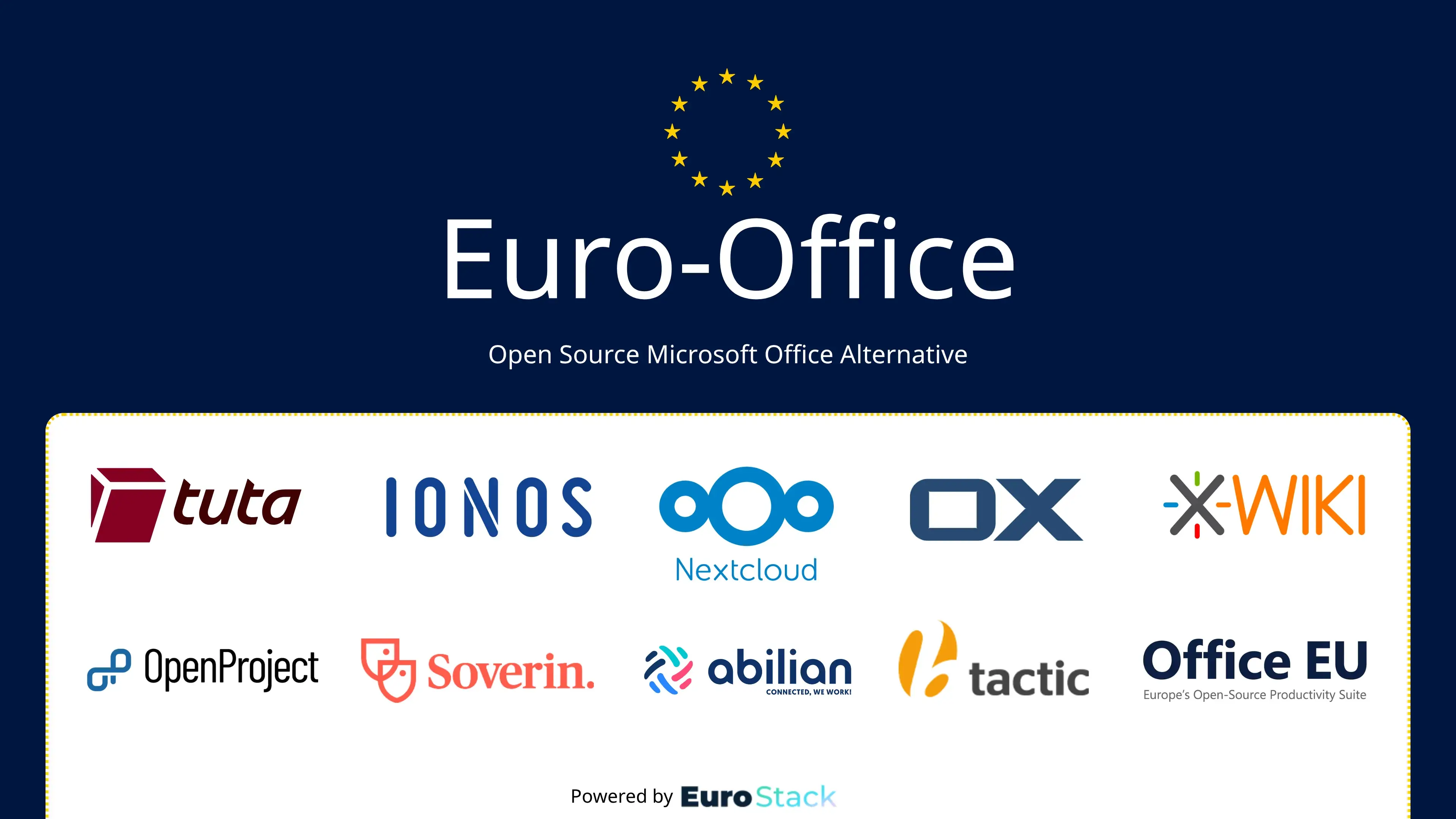
- developed by a European coalition (Nextcloud, IONOS, XWiki, OpenProject, Soverin, ...)
This initiative was officially announced earlier in 2026 as a joint European effort to build a sovereign office suite (see official announcement).
Important to understand: Euro‑Office is not a standalone platform.
It is primarily designed to integrate into existing environments such as Nextcloud, project management tools or knowledge platforms.
The first stable version becomes available on June 9, alongside its integration in Nextcloud Hub (read release details).
Why this is happening now
The demand for solutions like this is not driven by technology but by concern. Organisations are increasingly asking different questions:
- Where is my data actually stored?
- Which jurisdiction applies to my platform?
- Who can enforce access?
- What happens if a supplier suddenly changes the rules?
We see a clear shift: companies are no longer evaluating tools purely on functionality.
Control, transparency and governance have become equally important.
Euro‑Office is a direct response to that shift and is supported by a broader European ecosystem of providers.
Why this matters strategically
This story is not really about software. It is about dependency. Today, most workplaces in Europe rely heavily on a small number of large vendors.
That works until it doesn’t. Now an actual alternative exists.. And that has immediate implications:
- vendor lock-in becomes negotiable
- organisations regain bargaining power
- risk becomes visible and discussable
- architecture becomes a strategic decision again
What this means for organisations
For most organisations today, Microsoft 365 will remain the default choice. However, something important is changing: a realistic alternative is now available for evaluation.
Especially relevant for:
- organisations with compliance requirements
- companies handling sensitive data
- SMEs wanting to reduce vendor dependency
- organisations planning future-proof or hybrid architectures
Reflection & conclusion
Euro‑Office is not about new features, but about a shift in posture. It signals that European alternatives are becoming viable, introducing real choice where there was none.
As a result, digital dependency is no longer just an IT concern — it’s a strategic business topic.
Other Articles

Attack Paths in Microsoft Defender
door Geert | dec 23, 2025

Microsoft Secure Score & Exposure Score
door Geert | dec 16, 2025

Inzicht in Microsoft 365-licenties voor KMO’s in België
door Geert | dec 3, 2025

AI in alle hoeken van het IT-landschap
door Geert | nov 26, 2025